ASTM standards for seamless steel pipe are material and product specifications that define requirements such as chemical composition, mechanical properties, dimensions, manufacturing, heat treatment and testing. Not every ASTM pipe standard specifies seamless manufacturing only. Some standards cover both seamless and welded pipe.
Seamless steel pipes only
A106 / A335 / A192 / A210 / A213 / A519
Seamless + welded steel pipes
A53 / A333 / A312 / A790
What ASTM Standards Cover Seamless Steel Pipe?
There is no single ASTM standard covering all seamless steel pipes.
Different ASTM specifications are written for different materials and services.
- ASTM A106/A106M — Seamless carbon steel pipe for high-temperature service
- ASTM A335/A335M — Seamless ferritic alloy-steel pipe for high-temperature service
- ASTM A333/A333M — Seamless and welded steel pipe for low-temperature service and other applications requiring notch toughness
- ASTM A312/A312M — Seamless, welded and heavily cold-worked austenitic stainless steel pipe
- ASTM A53/A53M — Black and hot-dipped galvanized welded and seamless steel pipe
ASTM’s current steel standards listing distinguishes between specifications that cover seamless products only and those that cover both seamless and welded products.
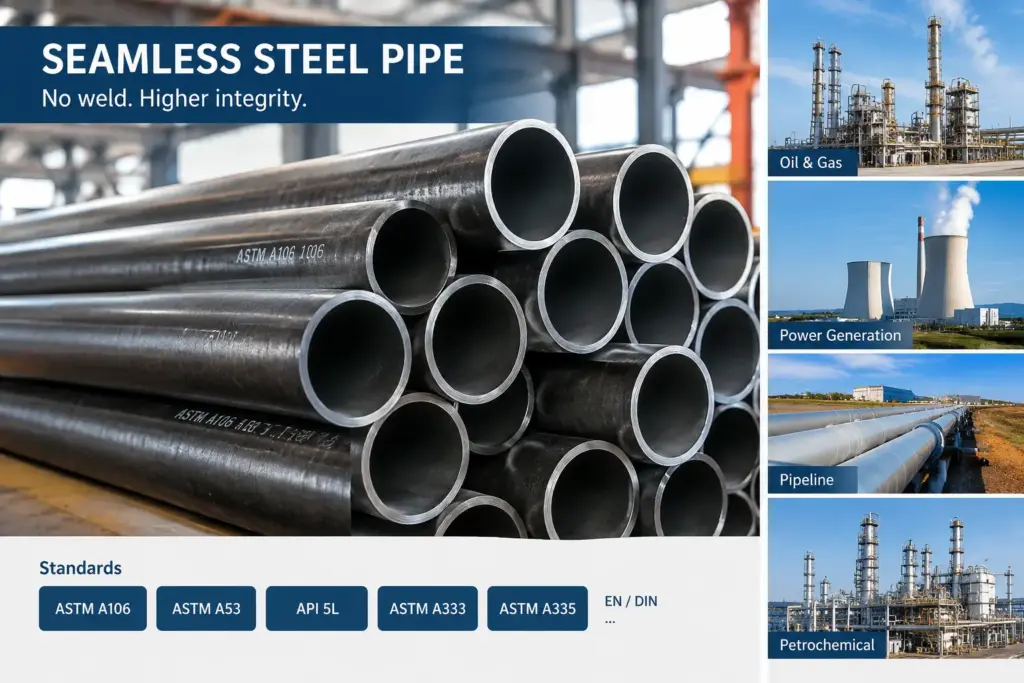
ASTM Standards That Specify Seamless Pipe Only
If your question is “Which ASTM standards specify seamless pipe manufacturing?”, the following specifications are important examples.
| ASTM Standard | Product | Manufacturing |
| A106/A106M | Carbon steel pipe for high-temperature service | Seamless |
| A335/A335M | Ferritic alloy-steel pipe for high-temperature service | Seamless |
| A192/A192M | Seamless carbon steel boiler tubes | Seamless |
| A210/A210M | Seamless medium-carbon steel boiler and superheater tubes | Seamless |
| A213/A213M | Seamless ferritic and austenitic alloy-steel boiler, superheater and heat-exchanger tubes | Seamless |
| A519/A519M | Seamless carbon and alloy steel mechanical tubing | Seamless |
These specifications do not all describe the same type of product. Some are intended for pressure piping, while others cover boiler tubes, heat-exchanger tubes or mechanical tubing.
ASTM’s current standards catalogue identifies A106, A335, A192, A210, A213 and A519 as seamless product specifications.
ASTM Standards That Cover Both Seamless and Welded Pipe
Several commonly requested ASTM specifications are not seamless-only standards.
ASTM A53
ASTM A53/A53M covers welded and seamless black and hot-dipped galvanized steel pipe. It is commonly used for mechanical and pressure applications involving air, steam, water and other general services.
Therefore, an inquiry for:
ASTM A53 Grade B pipe
does not automatically mean that the supplier should quote seamless pipe.
The purchase order should state the required manufacturing type.
ASTM A333
ASTM A333/A333M covers seamless and welded steel pipe for low-temperature service and other applications requiring notch toughness.
The specific grade and impact-testing requirements should be confirmed from the project specification.
ASTM A312
ASTM A312/A312M covers seamless, welded and heavily cold-worked austenitic stainless steel pipe.
It is commonly associated with stainless steel grades such as 304/304L and 316/316L, depending on the applicable requirements.
This means A312 should not be described simply as a “seamless-only” standard.
ASTM A106: A Common Standard for Seamless Carbon Steel Pipe
ASTM A106/A106M is one of the most commonly specified ASTM standards for seamless carbon steel pipe used in high-temperature service.
ASTM describes A106 as a specification covering seamless carbon steel pipe for high-temperature service. The specification includes NPS 1/8 through NPS 48, with wall thicknesses referenced to ASME B36.10M.
Common grades include:
- ASTM A106 Grade A
- ASTM A106 Grade B
- ASTM A106 Grade C
A106 Grade B is widely encountered in industrial piping inquiries.
Typical applications include:
- Refineries
- Process piping
- Power plants
- Steam systems
- Petrochemical facilities
- High-temperature fluid service
When requesting A106 pipe, buyers should specify the nominal size, schedule or wall thickness, length, pipe ends and inspection requirements in addition to the material standard.
ASTM A335: Seamless Alloy Steel Pipe for High-Temperature Service
ASTM A335/A335M covers seamless ferritic alloy-steel pipe for high-temperature service.
Common grades include:
- P5
- P9
- P11
- P22
- P91
The chromium and molybdenum alloying system is used for applications where elevated-temperature performance is required.
Typical applications include:
- Power generation
- Boilers
- Steam piping
- Petrochemical plants
- Refinery process systems
The correct grade should be selected according to design temperature, pressure, material compatibility and the applicable engineering specification.
ASTM A333: Seamless and Welded Pipe for Low-Temperature Service
ASTM A333/A333M covers seamless and welded steel pipe intended for low-temperature service and applications where notch toughness is required.
A buyer requiring seamless A333 pipe should state the manufacturing type clearly in the inquiry or purchase specification.
Applications can include:
- LNG-related systems
- Refrigeration systems
- Low-temperature process piping
- Cold-climate industrial facilities
The applicable grade and impact-test requirements should be confirmed before ordering.
ASTM A53: Seamless or Welded General-Service Pipe
ASTM A53/A53M covers both seamless and welded steel pipe. ASTM’s specification includes black and hot-dipped zinc-coated pipe.
A53 is commonly used for:
- Water lines
- Air lines
- Steam service
- General industrial piping
- Structural and mechanical applications
If seamless construction is required, the RFQ should state:
ASTM A53 Grade B, Seamless
This avoids ambiguity during quotation.
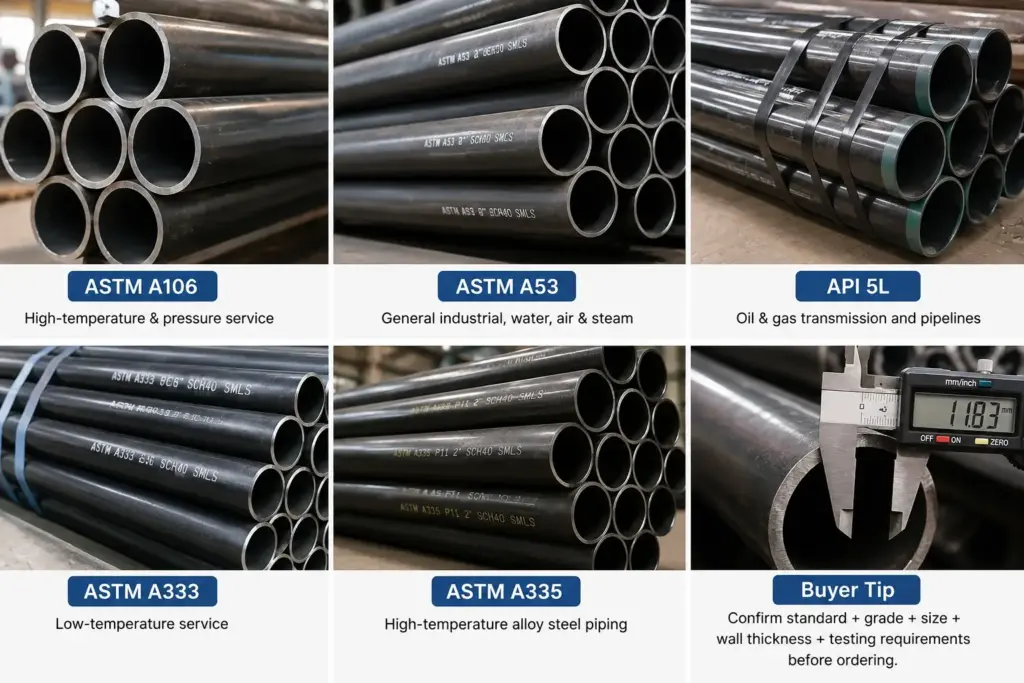
Straight Seam Steel Pipe vs Seamless Steel Pipe
Straight seam steel pipe and seamless steel pipe are different products.
A straight seam steel pipe is manufactured from steel plate or coil that is formed into a cylindrical shape and joined along a longitudinal seam by welding.
A seamless steel pipe starts from a solid billet and is produced without a longitudinal weld seam.
| Feature | Straight Seam Steel Pipe | Seamless Steel Pipe |
| Longitudinal weld | Yes | No |
| Basic starting material | Plate or coil | Solid billet |
| Manufacturing | Forming + longitudinal welding | Piercing + rolling/drawing |
| Common applications | Water, structural and industrial pipeline systems | Pressure, high-temperature and demanding industrial service |
| ASTM examples | A134 and other welded-pipe specifications | A106, A335 and other seamless specifications |
The term straight seam therefore should not be used as another name for seamless pipe.
ASTM Standards for Straight Seam Steel Pipe
One example is ASTM A134/A134M, which covers electric-fusion arc-welded straight seam or spiral seam steel pipe in NPS 16 and larger.
This is why the search phrase “straight seam steel pipe ASTM standard” should be interpreted as a welded-pipe question rather than a seamless-pipe question.
Applications of Seamless Steel Pipe by ASTM Standard
The appropriate ASTM standard depends on the service rather than simply the industry name.
| Application | Typical ASTM specification | Product type |
| High-temperature carbon steel piping | A106 | Seamless |
| General-purpose steel piping | A53 | Seamless or welded |
| Low-temperature service | A333 | Seamless or welded |
| High-temperature alloy-steel piping | A335 | Seamless |
| Austenitic stainless steel piping | A312 | Seamless or welded |
| Boiler and heat-exchanger tubes | A192 / A210 / A213 | Seamless |
| Mechanical tubing | A519 | Seamless |
This table should be used as a starting point only. The final specification must come from the project design, applicable code and operating conditions.
How to Select the Right ASTM Seamless Pipe Standard
Before ordering seamless steel pipe, confirm these points:
1. Service condition
Identify whether the pipe will operate under:
- High temperature
- Low temperature
- High pressure
- Corrosive service
- General fluid service
- Mechanical loading
2. Material grade
For example:
- A106 Grade B
- A333 Grade 6
- A335 P11
- A335 P22
- A312 TP304/304L
- A312 TP316/316L
3. Pipe dimensions
Specify:
- NPS or DN
- Outside diameter
- Wall thickness
- Schedule
- Length
For A106, ASTM references ASME B36.10M for nominal wall thicknesses.
4. Manufacturing type
If the project requires seamless pipe, state:
Seamless / SMLS
Do not assume that a material specification automatically means seamless when the ASTM specification permits both seamless and welded manufacturing.
5. Testing and inspection
Depending on the order, requirements may include:
- Chemical analysis
- Tensile testing
- Yield strength
- Elongation
- Hydrostatic testing
- Nondestructive examination
- Impact testing
- Dimensional inspection
- Visual inspection
- Mill Test Certificate
Additional third-party inspection requirements should be agreed before production.
What Should Be Included in a Seamless Pipe RFQ?
A useful seamless steel pipe inquiry should look something like:
ASTM A106 Grade B Seamless Pipe, NPS 6, SCH 40, 12 m length, beveled ends, 200 pcs, MTC EN 10204 3.1 required.
For a project order, also provide:
- Applicable project specification
- Delivery destination
- Inspection requirements
- Coating or preservation requirements
- Required certificates
- Packing requirements
The more complete the specification, the less risk there is of receiving a quotation for the wrong product.
FAQ: ASTM Standards for Seamless Steel Pipe
Which ASTM standard is used for seamless carbon steel pipe?
ASTM A106/A106M is a major ASTM specification for seamless carbon steel pipe used for high-temperature service. Other specifications apply depending on temperature, pressure, toughness and the intended application.
Which ASTM standards specify seamless pipe only?
Examples include ASTM A106/A106M and ASTM A335/A335M for steel pipe, while A192, A210, A213 and A519 cover specific seamless tube or mechanical tubing products. Always check the scope of the individual ASTM specification.
Is ASTM A53 seamless or welded?
ASTM A53/A53M covers both seamless and welded steel pipe. If seamless construction is required, it should be stated in the purchase specification.
Is ASTM A333 seamless pipe?
ASTM A333/A333M covers both seamless and welded steel pipe for low-temperature service and other applications requiring notch toughness. The required manufacturing type should therefore be specified separately.
Is ASTM A312 seamless pipe?
ASTM A312/A312M covers seamless, welded and heavily cold-worked austenitic stainless steel pipe. It is not a seamless-only specification.
What is the ASTM standard for straight seam steel pipe?
There is no single ASTM standard covering all straight seam steel pipe. ASTM A134/A134M, for example, covers electric-fusion arc-welded straight seam or spiral seam steel pipe in NPS 16 and larger. Other welded-pipe applications may fall under different ASTM specifications.
What is the difference between straight seam and seamless pipe?
Straight seam pipe has a longitudinal welded seam. Seamless pipe is manufactured without a longitudinal weld seam. They are separate manufacturing categories and should be specified accordingly.
Need ASTM Seamless Steel Pipe?
For a quotation, send the ASTM standard, grade, pipe size, schedule or wall thickness, length, quantity and required inspection documents.
For project orders, you can also send the project specification or material list so the pipe requirements can be checked before quotation.
JS FITTINGS–Industrial steel pipes, butt weld fittings and flanges supplier in China
Email: admin@jsfittings.com
WhatsApp: +86 180 0311 9682
Comments
Post a Comment