ASTM A106 Grade B Pipe Specification: Properties, Size Range, and Material Comparisons (A106 vs. A333 / A53 / API 5L)
ASTM A106 (ASME SA106) Grade B is the standard specification for seamless carbon steel pipe for high-temperature, high-pressure service. Engineered specifically for process piping, steam lines, and refinery furnaces, it must be manufactured from fully deoxidized (“killed”) steel to ensure structural integrity under thermal load.
1. ASTM A106 Grade B Engineering
| Parameter | ASTM A106 Grade B Specification |
| Manufacturing Process | Strictly Seamless (Hot Finished or Cold Drawn) |
| Steel Metallurgy | Fully Killed Carbon Steel |
| Min. Yield Strength | 240 MPa (35,000 psi / 35 ksi) |
| Min. Tensile Strength | 415 MPa (60,000 psi / 60 ksi) |
| Elongation in 2 in. (50mm) | Standard min. 30% (longitudinal), varies with wall thickness |
| Standard Size Range | NPS 1/8” to NPS 36” (Custom ODs up to 48” upon request) |
| Standard Schedules | Sch 20, Sch 30, Sch 40, STD, Sch 80, XS, Sch 160, XXS |
2. Chemical Composition Requirements (% Max, Heat Analysis)
The performance of A106B in high-temperature applications depends heavily on its carbon, manganese, and silicon balance:
- Carbon (C): Max 0.30%
- Manganese (Mn): 0.29% – 1.06%
- Phosphorus (P): Max 0.035%
- Sulfur (S): Max 0.035%
- Silicon (Si): Minimum 0.10% (Crucial: Ensures the steel is fully killed for creep resistance)
- Residual Elements (Cr, Cu, Mo, Ni, V): Combined total must not exceed 1.00% under ASTM specifications.
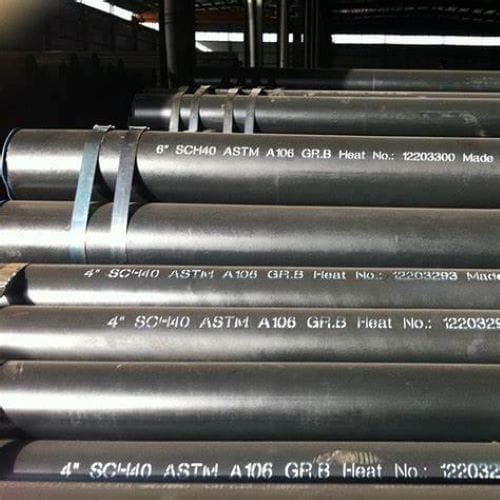
3. High-Intent Material Comparison: A106 vs. Similar Grades
Engineers and procurement teams often encounter overlaps among A106, A333, A53, and API 5L.
A106 vs. A333: High Temperature vs. Low Temperature
The comparison between ASTM A106 Grade B and ASTM A333 Grade 6 is one of the most common material selection questions:
| Evaluation Factor | ASTM A106 Grade B | ASTM A333 Grade 6 |
| Design Service Temp. | Elevated temperatures (up to 425°C / 800°F) | Low/Cryogenic temperatures (down to -45°C / -50°F) |
| Charpy V-Notch Impact | Not mandatory under standard A106 testing | Mandatory at -45°C (-50°F) |
| Manufacturing Method | Seamless only | Seamless or Welded (without filler metal) |
| Typical Use Case | Power plant steam lines, process furnaces | LNG facilities, cold climate gas piping, refrigeration |
Key Rule: Never substitute A106B for sub-zero applications without supplementary Charpy impact qualification. A106 undergoes ductile-to-brittle transition as temperatures drop, risking sudden brittle fractures.
A106 vs. ASTM A53 Grade B vs. API 5L Grade B
| Grade | Seamless / Welded | Target Application | Deoxidation Method |
| ASTM A106 Gr. B | Seamless Only | High-temp & high-pressure steam/fluid transport | Killed Steel mandatory |
| ASTM A53 Gr. B | Seamless (Type S) or Welded (Type E/F) | General utility, plumbing, structural, low-temp lines | Not strictly killed |
| API 5L Gr. B | Seamless or Welded (ERW, LSAW, SSAW) | Oil, gas, and hydrocarbon transmission pipelines | Per PSL1 / PSL2 spec |
| ASME SA106 Gr. B | Seamless Only | ASME Boiler & Pressure Vessel Code (BPVC) construction | Equivalent to ASTM A106 |
- A106 vs A53: While A53 Type S (Seamless) Grade B shares identical minimum tensile (415 MPa) and yield (240 MPa) values, A53 permits higher phosphorus/sulfur contents and does not require killed steel processing. A53 is not intended for sustained high-temperature service.
- A106 vs API 5L: API 5L Grade B is common in cross-country transmission. Dual-certified pipe (A106-B / API 5L-B / A53-B) is widely held in stock by distributors, provided the heat analysis satisfies all three criteria simultaneously and is manufactured seamless.
4. Size Availability, Schedules, and Wall Thickness
A106 Grade B seamless pipes are supplied in standard wall thicknesses per ASME B36.10M:
- NPS 1/8” to NPS 1-1/2”: Commonly used for instrumentation lines, branch piping, and auxiliary connections.
- NPS 2” to NPS 12”: Main steam distribution, boiler feed piping, and refinery header lines.
- NPS 14” to NPS 36” (and up to 48”): Heavy-wall hot-finished seamless for main process lines and critical headers.
Lengths & Ends:
- Lengths: Single Random (SRL: 16–22 ft), Double Random (DRL: 35–44 ft), or exact cut lengths.
- End Finish: Plain End (PE) or Beveled End (BE: 30° / 37.5° for field butt-welding).
5. Mandatory Inspection & Mill Testing Requirements
To comply with global EPC and stockist standards, each production run of A106 Grade B requires verification documentation:
- Hydrostatic Test: Each length must undergo hydrostatic testing to inspect pressure boundary stability (stressing the pipe to a minimum 60% of specified yield strength).
- Non-Destructive Examination (NDE): Eddy current or ultrasonic testing (UT) can replace or accompany hydrostatic testing per customer requisition.
- Tensile & Flattening/Bend Tests: Conducted per heat to verify ductility and weld-zone stability.
- Mill Test Certificate (MTC): Issued in strict accordance with EN 10204 3.1 or 3.2, reporting actual chemical heat values, mechanical results, and hydrostatic test pressures.
6. Sourcing & Stockist Inquiries: Fast Technical Checklist
When issuing a Purchase Order (PO) or Request for Quotation (RFQ) for A106B seamless pipes, define the following variables to eliminate quoting delays:
- Nominal Size & Schedule: e.g., NPS 6” SCH 80 (or exact OD x WT in mm).
- Length Type: SRL, DRL, or fixed container-optimized lengths (e.g., 5.8m or 11.8m).
- Surface Protection: Black varnished (anti-rust oil), bare, or external 3LPE/FBE coated.
- Certification: EN 10204 3.1 with specific Third-Party Inspection requirements (SGS, BV, TUV)
Order ASTM A106 B seamless steel pipe from JS FITTINGS
JS FITTINGS-Leading Steel Pipes Supplier Since 1983
We are the top supplier in the supply and export of seamless steel pipes, ERW steel pipes, LSAW, and SSAW steel pipes.
We specialize in high-quality carbon steel pipes, offering a comprehensive range of specifications, including SCH 40, SCH 80, and SCH 160 carbon steel pipes, designed to meet international standards such as ASTM, API, and DIN.
Backed by a complete set of testing facilities, our company strictly abides by the ISO 9001 quality management system and has been certified by numerous authoritative TPI organizations.
The company’s partners span Southeast Asia, the Middle East, Europe, Africa, and over 100 countries and regions.
Based in Yanshan, Cangzhou, China, we are known across industries as a dependable supplier of carbon steel pipes. JS FITTINGS aims to collaborate with you to find the best solution for your project.
Email: info@jssteelpipes.com
WhatsApp: +8618003119682
Comments
Post a Comment